

Advantages and Limitations of Local AI Infrastructure for Enterprises
1. Why Enterprises Are Reconsidering Where AI Runs
Enterprise AI is moving from isolated experiments into normal business processes. In 2025, 20% of EU enterprises with at least ten employees used AI technologies, up from 13.5% in 2024. Among large enterprises, adoption reached 55%. The practical question is therefore no longer whether companies will use AI, but which data and workflows should be entrusted to which infrastructure.
Public AI services provide rapid access to powerful models for research, drafting, coding and analysis. They become more difficult to govern when employees want to process contracts, source code, engineering documents, customer records or internal reports. In those cases, model quality is only one concern. The organisation must also know where prompts and files are processed, what is retained, who can access the results and how the service connects to existing permissions.
Local AI infrastructure offers an alternative by running models and related services inside an environment controlled by the enterprise. This can reduce external data transfers, support internal governance and make AI available in restricted or disconnected networks.
The central conclusion of this article is deliberately narrower than “local is better”:
Local AI is most valuable for sensitive, stable and clearly defined workloads. It is not automatically safer, cheaper or more capable than a well-governed cloud service.
European regulation reinforces the need for deliberate deployment. The EU AI Act entered into force in August 2024 and becomes applicable in stages, with further major provisions scheduled around August 2026. Local processing may support access control, monitoring and documentation, but it does not itself create compliance.
The right starting questions are therefore:
- Which information genuinely benefits from internal processing?
- Can a locally deployable model complete the task reliably?
- Can the organisation operate the environment over its full lifecycle?
2. What Is Local AI Infrastructure?
Local AI infrastructure is an environment in which AI processing takes place within computing resources controlled by the organisation. The defining factor is the control boundary, not necessarily the physical location of the server.
A local system may run on a specialist workstation, an internal GPU server, a colocated data centre, a private-cloud environment or an industrial edge device. On-premises AI usually refers to equipment located in the company’s own facilities. Private AI is broader and can include dedicated external infrastructure. Hybrid AI combines internally operated components with approved cloud models or services.
Installing an open-weight model does not create an enterprise-ready platform. A production environment normally includes five connected layers:
- Access: user interface, APIs, authentication and permissions
- Application: prompts, workflow logic and routing rules
- Model layer: inference software, models and computing resources
- Knowledge layer: OCR, document ingestion, embeddings, retrieval and databases
- Operations: monitoring, logging, backups, updates and security controls
Consider an internal knowledge assistant. Its model may run locally, while telemetry is still sent externally. The vector database may contain confidential passages, logs may reproduce complete prompts, and the retrieval system may ignore permissions from the original document repository. The model is therefore only one component of the security architecture.
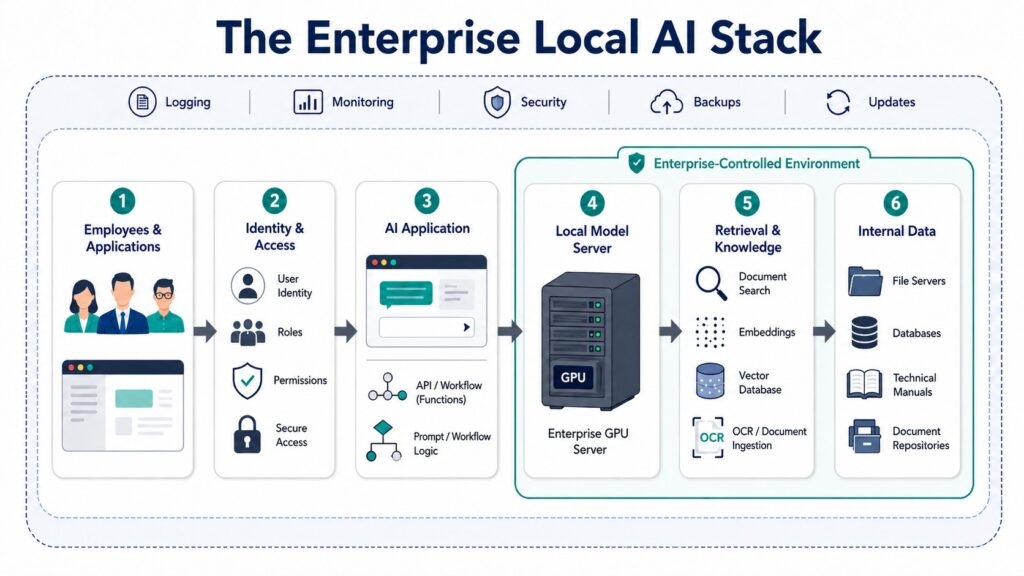
A usable architecture must establish where every copy of the data is stored, how permissions are enforced, what happens when the local model cannot complete a task and whether sensitive and non-sensitive workloads can be separated safely.
Our Approach: A Tailored Local and Hybrid AI Environment
Protected AI implements a locally controlled AI environment using Gemma 4, Ollama and a browser-based interface. Depending on the use case, the system can be connected to internal documents, protected through user and access controls, and integrated with existing business applications. Sensitive prompts and company knowledge are processed locally, while approved non-confidential tasks can be routed to external models when greater reasoning power or current information is required.
We consider this hybrid architecture the most practical approach for many enterprises: it combines internal control with access to advanced AI capabilities. Unlike a fixed proprietary platform, the infrastructure can be adapted to the company’s systems, models and operational requirements.
3. Advantages and Limitations at a Glance
Local AI increases control, but it also increases responsibility.
| Decision area | Potential advantage | Main limitation |
|---|---|---|
| Data | Prompts, documents, embeddings and outputs can remain controlled | Poor permissions or insecure logs can still expose information |
| Governance | Authentication, retention and audit rules can follow internal policies | The enterprise must design and maintain those controls |
| Integration | AI can connect directly to internal systems and knowledge | Legacy systems and poor data quality complicate deployment |
| Performance | Capacity can be reserved for internal workloads and offline use | Throughput is limited by owned hardware |
| Model choice | The enterprise controls versions, updates and task routing | Local models may be weaker on complex tasks |
| Cost | Stable, high utilisation can make fixed infrastructure economical | Low adoption creates expensive idle capacity |
| Independence | Exposure to API outages and provider changes is reduced | Hardware, frameworks and model licences create new dependencies |
The strongest case emerges where sensitive information, predictable demand and a verifiable business process come together. The case weakens when usage is irregular, frontier-level capabilities are essential or operational ownership is missing.
4. Advantages of Local AI Infrastructure
4.1 Greater Control Over Sensitive Data
Local processing can keep prompts, uploaded files, retrieved passages, embeddings and outputs within an environment governed by the enterprise. This is relevant for contracts, customer records, product plans, engineering documentation, source code and internal correspondence.
The benefit is not simply that the server is nearby. The enterprise can decide where information is stored, how long it is retained and which identities or services may access it. That can reduce exposure to third-party processing and support stricter handling rules for particular departments or projects.
However, data location is not data security. NIST’s zero-trust approach rejects the assumption that users or systems should be trusted merely because they are inside a corporate network. Local AI still requires authentication, authorisation, encryption, segmentation and protected logs.
4.2 Governance Can Follow Existing Permissions
An enterprise assistant should not turn separate HR, finance, engineering and sales repositories into one unrestricted knowledge pool.
A properly designed local system can integrate with single sign-on, role-based access and document-level permissions. Retrieval should be filtered at query time so that the assistant returns only information the requesting user is authorised to see. Retention rules and audit logs can also be aligned with existing organisational policies.
This is one of the strongest advantages of a controlled environment: governance can extend through the complete application rather than being limited to the account settings of an external chatbot.
4.3 Better Adaptation to Internal Workflows
The most useful enterprise systems are rarely generic chatbots. They support a specific process: a technical assistant that cites approved manuals, an OCR pipeline that extracts predefined fields, a contract tool that identifies clauses or a classification service that returns an exact category code.
Local infrastructure gives developers control over the retrieval method, prompts, output schemas, validation steps and escalation rules. A smaller model connected to reliable company knowledge may outperform a larger general-purpose model for a narrow task.
This also improves observability. When an answer is wrong, teams can inspect whether the failure came from poor OCR, outdated documents, weak retrieval, an unsuitable prompt or the model itself. Replacing the model is not always the correct remedy.
4.4 Predictable Availability and Latency
Local capacity can be reserved for internal workloads. This is useful for high-volume OCR, technical knowledge search, document classification, production environments and sites with unreliable connectivity.
The benefit is controllability rather than unlimited speed. Performance must be tested with realistic document lengths, concurrent users and peak loads. A model that feels fast for one user may become unusable when several departments access it simultaneously.
For edge and industrial applications, local processing can also avoid repeatedly transferring large data volumes and allow essential functions to continue when an external API is unavailable.
4.5 Control Over Models and Update Cycles
Cloud providers can replace models, retire versions or change usage limits. Local infrastructure allows an enterprise to decide which model remains in production, when an update is introduced and how a new version is evaluated.
This is valuable for repeatable workflows in which consistent behaviour matters. A classification or extraction system should not change unexpectedly because its underlying model was replaced.
Model choice can also be task-specific. One efficient model may handle classification, another internal model may support document analysis, and an external model may be reserved for approved complex requests.
4.6 Potentially More Predictable Costs
Cloud AI converts infrastructure into variable usage fees. Local AI shifts costs towards hardware, implementation, electricity, maintenance and support.
Neither is inherently cheaper. Local infrastructure becomes economically attractive when utilisation is high, stable and spread across several workflows. Once capacity is available, the marginal cost of an additional request may be low. If adoption remains weak, the same server becomes expensive idle capacity.
The genuine advantage is therefore cost predictability under known workloads—not guaranteed savings.
5. Limitations and Challenges
5.1 Hardware Requirements and Fixed Capacity
Open-weight does not mean inexpensive to operate. Meta’s Llama 3.1 family, for example, includes 8B, 70B and 405B parameter models. At 16-bit precision, the weights of a 70B model alone require roughly 140 GB of memory before additional capacity for context, concurrent users and the inference framework is considered. Quantisation reduces memory requirements, but may affect quality and does not remove the need for careful sizing.
A demonstration that runs on a workstation says little about production performance. Enterprises must account for peak concurrent users, long documents, batch workloads, redundancy and future model requirements.
Local capacity is also fixed. Sizing for average demand can create queues during peaks; sizing for rare peaks produces underused hardware. High availability may require a second server that remains partly idle in normal operation.
5.2 The Full Operational Burden
Local AI is not installed once and then left unchanged. Teams must maintain operating systems, drivers, inference frameworks, containers, storage, backups, monitoring, identities and model licences.
Updates can alter more than technical compatibility. A new model version may change answer style, extraction accuracy or refusal behaviour. Production changes therefore need regression tests, documented releases and rollback options.
The total cost of ownership should include integration, data preparation, electricity, cooling, administration, security review, user support, downtime and hardware replacement. Staff time is frequently underestimated.
5.3 Model Quality May Be Insufficient
Open models have improved rapidly. Stanford’s 2025 AI Index reported that the gap between the leading closed- and open-weight models on one prominent leaderboard had narrowed from 8.04% in early 2024 to 1.7% by February 2025. That is meaningful progress, but it does not prove that a model practical for local deployment will match a leading hosted service on a company’s tasks.
The strongest open model may exceed the available hardware. Smaller or quantised variants may perform differently. Public benchmarks may not reflect German contracts, specialist terminology or company-specific document quality.
Evaluation must therefore use the exact model, quantisation, hardware, prompts and retrieval configuration intended for production. The relevant question is not whether the model is generally impressive, but whether it meets an agreed quality threshold for the business process.
5.4 Integration Is Often Harder Than Hosting
A language model can be downloaded quickly. Reliable access to enterprise knowledge is much harder.
Documents may be distributed across file servers, wikis, databases and specialist applications. They may contain poor scans, missing metadata, duplicate versions and contradictory information. In a retrieval-augmented generation system, errors propagate: poor OCR leads to weak indexing, weak indexing leads to irrelevant retrieval, and the model then produces a fluent answer based on the wrong material.
Permissions add another challenge. A local model can still expose confidential information if the retrieval layer does not reproduce the rights of the source systems.
This is why enterprise AI quality often depends more on data preparation and process design than on selecting a larger model.
5.5 Security and Output Risks Remain
Local deployment does not eliminate prompt injection, vulnerable dependencies, compromised accounts, malicious documents or sensitive information in logs. OWASP lists prompt injection and sensitive-information disclosure among the principal risks for LLM applications.
Retrieved content should be treated as untrusted input. Models should have only the tools and permissions they require, and generated output should be validated before it triggers actions.
Recent case: Plugins and Extensions Increase Security Risks
Users of locally installed AI agents such as OpenClaw have reported security incidents involving malicious community plugins or “skills.” Because these extensions may receive access to the local file system, network connections, credentials and command-execution tools, installing an untrusted plugin can be comparable to running unknown software directly on the workstation. Security researchers have identified OpenClaw extensions designed to install information-stealing malware and extract browser passwords, API keys, cryptocurrency credentials and SSH access data. OpenClaw’s own documentation therefore warns that a malicious native plugin can effectively execute arbitrary code within the agent process. Local operation protects data from an external AI provider, but it does not protect the device from unsafe extensions, compromised dependencies or malicious code introduced through the plugin ecosystem. (Source)
Local models also remain probabilistic. They can omit exceptions, misread a source or generate plausible but unsupported statements. High-impact outputs require safeguards such as citations, structured validation, qualified human review or refusal when evidence is insufficient.
The organisation deploying the system remains responsible for how its output is used.
6. When Local AI Is a Good Fit
A practical assessment can be organised around four gates.
| Gate | Key question | Strong indication for local AI |
|---|---|---|
| Data | Is internal processing materially valuable? | The workflow uses restricted, proprietary or operational data |
| Capability | Can a deployable model meet the quality threshold? | The task is narrow, repeatable and testable |
| Economics | Does demand justify fixed capacity? | Usage is frequent and predictable |
| Operations | Can the system be maintained and governed? | Ownership, security and support are established |
Strong candidates include internal knowledge search, local OCR, document classification, technical support assistants, information extraction and industrial edge processing.
These uses share several characteristics: the information is valuable, the process recurs, the expected output can be checked and the consequences of failure can be controlled.
A useful local-AI project is more specific than “provide an internal ChatGPT”. For example:
Technicians should be able to search approved maintenance manuals, receive cited passages and access only the product areas for which they are authorised.
That statement defines users, data, output and restrictions. It can be tested.
The best candidates also have verifiable results. Extracted invoice values can be compared with the document; a support answer can cite its manual; a classification can be checked against known categories. Open-ended strategic advice is far harder to validate.
Local AI is most convincing when it enables a recurring process that an ordinary external assistant cannot support safely or reliably.
7. When Local AI May Not Be the Best Choice
A managed or cloud-based approach is often more rational when:
- The use case is still experimental.
- Demand is infrequent, highly variable or dominated by short peaks.
- The task requires the strongest reasoning, coding or multimodal models.
- Current external information is central to the workflow.
- The organisation lacks long-term operational ownership.
- A managed enterprise service already satisfies the required controls.
Cloud services allow teams to test models and demand before committing to hardware. They also provide elasticity for temporary workloads and faster access to new capabilities.
The correct comparison is not local AI versus an uncontrolled consumer chatbot. Professionally managed services may offer identity integration, private networking, regional processing, configurable retention and contractual controls. These must be assessed carefully, but they can provide a stronger operational baseline than a poorly maintained internal installation.
A controlled pilot is often the better first step when requirements are unclear:
Validate the workflow → measure quality and demand → classify the data → select the infrastructure.
Buying hardware first reverses that sequence.
8. Local, Cloud or Hybrid AI?
The deployment model should be selected per workload, not once for the entire company.
| Workload characteristic | Local | Cloud | Hybrid |
|---|---|---|---|
| Sensitive internal data | Strong | Depends on provider and controls | Strong for the sensitive portion |
| Stable, continuous demand | Strong | Possible | Strong |
| Irregular or rapidly growing demand | Limited | Strong | Strong |
| Frontier-model capability required | Limited by hardware and models | Strong | Strong |
| Offline or edge operation | Strong | Weak | Partial |
| Operational effort | High | Lower | Medium to high |
| Routing and governance complexity | Moderate | Moderate | Highest |
Airbus: Local and External AI in Parallel
Airbus illustrates this selective approach. Its 2025 board report describes both the rollout of Gemini for Workspace and an on-premises generative-AI platform in Germany and Spain for restricted data. Airbus reported more than 15,000 users of the internal platform, including document and code assistants. The example is company-reported rather than an independent effectiveness study, but it shows why a large enterprise may use local and external AI in parallel rather than make one universal choice.
Hybrid AI is not simply a compromise. It is a routing architecture. The organisation must determine whether a request contains sensitive information, which model can complete it and what may leave the internal environment.
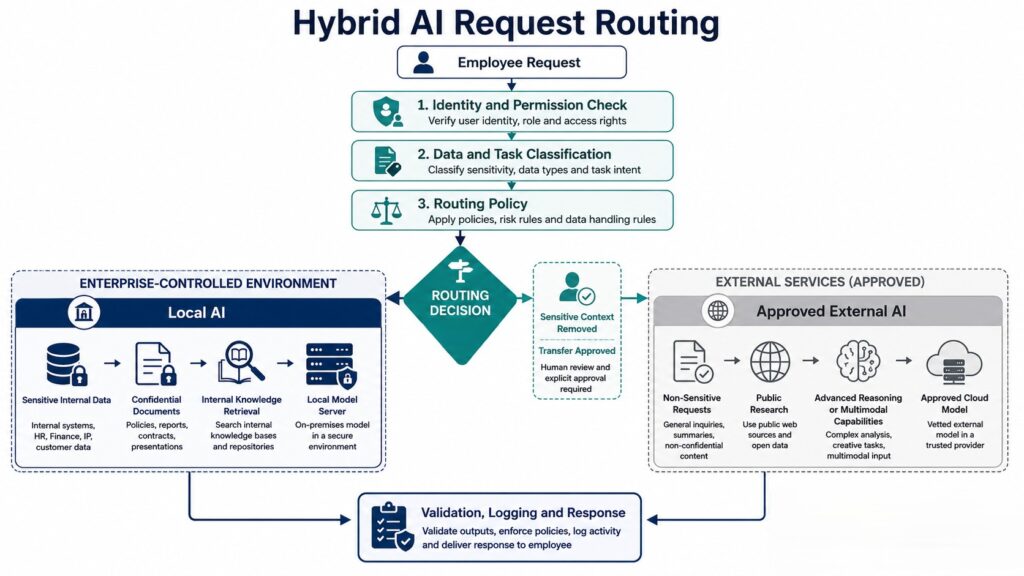
Three rules should be explicit:
- What must never leave the controlled environment?
- Which tasks are approved for external processing?
- Who or what may authorise an exception?
Hybrid architecture can provide the best balance of control and capability, but it also creates more interfaces, credentials, logs and failure points.
Portability should be considered from the start. The EU Data Act, applicable since September 2025, includes provisions intended to facilitate switching and interoperability between data-processing services. Technical lock-in can still remain, so enterprises should keep data exportable, separate business logic from individual model APIs and retain independent evaluation datasets.
9. Questions to Answer Before Deployment
A successful demonstration is not proof of production readiness. Before approval, decision-makers should expect evidence in five areas.
1. Value
What measurable process will improve? Establish the current time, cost or error rate and define the expected result. “Introduce AI” is not a business case.
2. Data
Map source documents, extracted text, embeddings, prompts, outputs, logs and backups. Record where each is stored, who can access it and whether any part is transferred externally.
3. Quality and Security
Test the production configuration with representative cases, including poor scans, contradictory documents, restricted information, unsupported questions and malicious instructions. The OWASP risks and NIST AI Risk Management Framework provide useful foundations for this review.
4. Capacity and Cost
Load-test expected concurrency, peak document sizes, indexing jobs and component failures. Build a multi-year cost model with expected, peak and low-adoption scenarios.
5. Ownership and Failure Handling
Name owners for the business process, infrastructure, permissions, source data, model changes, quality evaluation and incidents. Define what happens when the AI is wrong: citation, validation, escalation, human approval, refusal or a decision not to automate.
A concise production evidence pack should contain:
- Use-case definition and prohibited uses
- Data-flow and access-control design
- Business-specific evaluation results
- Load and recovery tests
- Threat assessment
- Human-oversight plan
- Operating and cost model
- Exit or migration plan
NIST structures AI risk management around Govern, Map, Measure and Manage. The framework’s practical lesson is that governance should continue after launch as models, documents, usage and threats change.
10. Conclusion: Local AI Is a Workload Decision
Local AI offers enterprises meaningful control over data, permissions, models, integrations and update cycles. It is particularly valuable for sensitive, stable and verifiable workloads that benefit from close integration with internal systems.
Its limitations are equally real. Hardware capacity is fixed, production operations require expertise, strong models can be expensive to host, and local deployment does not eliminate security or output risks.
The mature approach is selective:
- Use local AI where internal control creates clear operational value.
- Use managed cloud AI where elasticity, current information or frontier capabilities matter more.
- Use hybrid routing where sensitive and non-sensitive parts of a workflow can be separated reliably.
- Do not deploy where quality, risk or ownership cannot be managed.
The most important question is not which model or server to buy. It is:
Which recurring business process becomes possible, safer or more efficient when AI runs within a controlled environment?
Once that question has a precise answer, infrastructure selection becomes an engineering decision rather than an ideological one.
Protected AI supports enterprises in assessing, designing and implementing local and hybrid AI environments around their actual data, workloads and operational capacity. The objective is not to maximise local processing, but to balance control, capability and cost deliberately.
Further Relevant Resources
The following resources provide deeper guidance on AI governance, security, infrastructure performance and European regulation:
- NIST AI Risk Management Framework
A structured framework for identifying, measuring and managing AI risks throughout the system lifecycle. It is particularly useful when defining responsibilities, evaluation processes and production approval criteria. - NIST Generative AI Profile
An extension of the AI Risk Management Framework focused specifically on generative AI risks, including inaccurate output, data protection, model misuse and human oversight. - OWASP Top 10 for LLM and Generative AI Applications
A practical overview of important security risks in LLM applications, including prompt injection, sensitive-information disclosure, supply-chain vulnerabilities and insecure model actions. - EU AI Act Overview
The European Commission’s official overview of the AI Act, its risk-based approach, implementation timetable and supporting guidance. Local deployment does not automatically satisfy the Act, but the rules may influence governance, documentation and oversight requirements. - EU Data Act Explained
Official guidance on the Data Act, including rules intended to improve cloud switching, interoperability and access to data generated by connected products and services. - MLPerf Inference Benchmarks
Vendor-neutral benchmarks for comparing the performance and efficiency of AI inference systems across data-centre, edge and other deployment environments. - Stanford AI Index Report 2026
An independent annual overview of AI development, including model performance, industry activity, adoption, investment and policy trends.

Leave a Reply