Our Solution
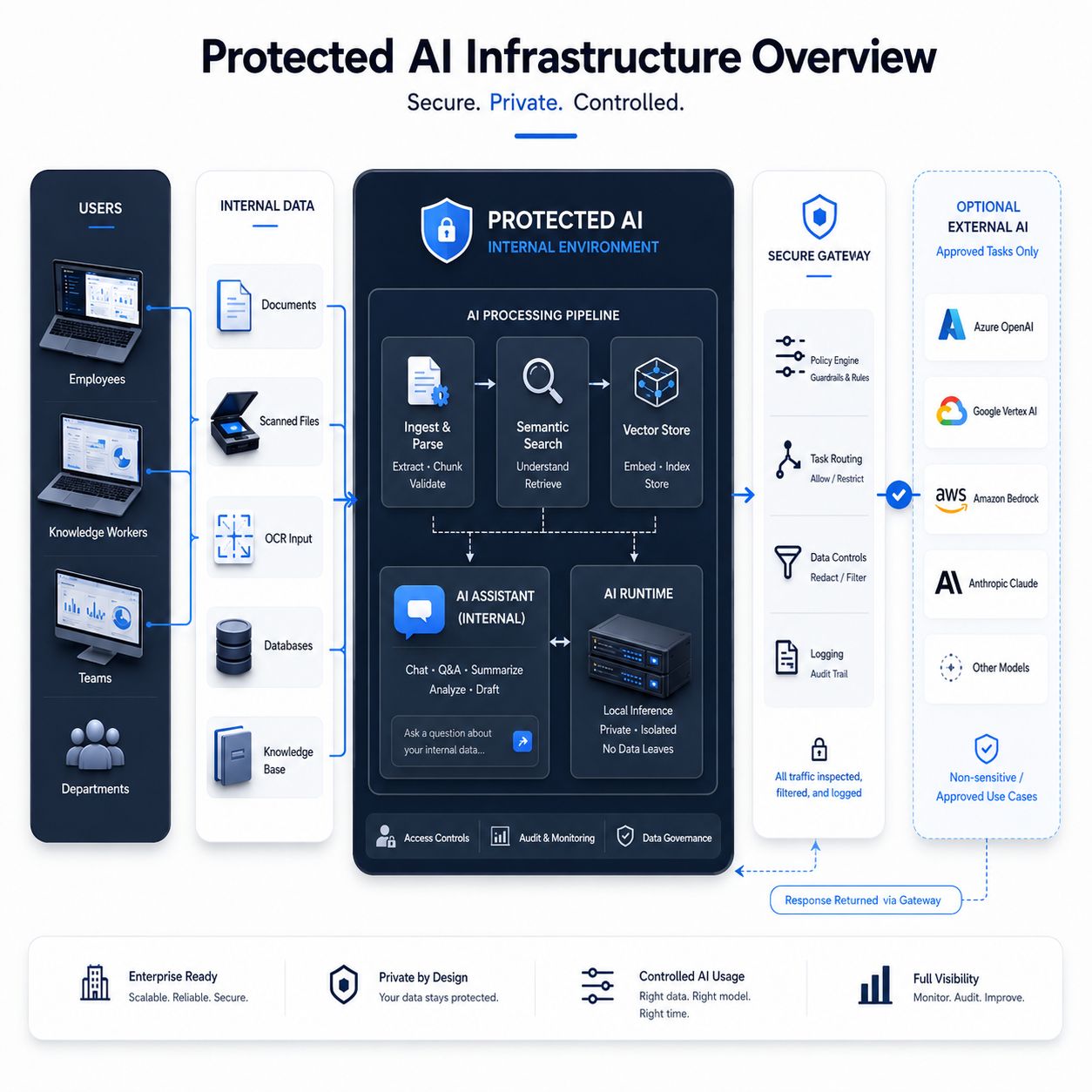
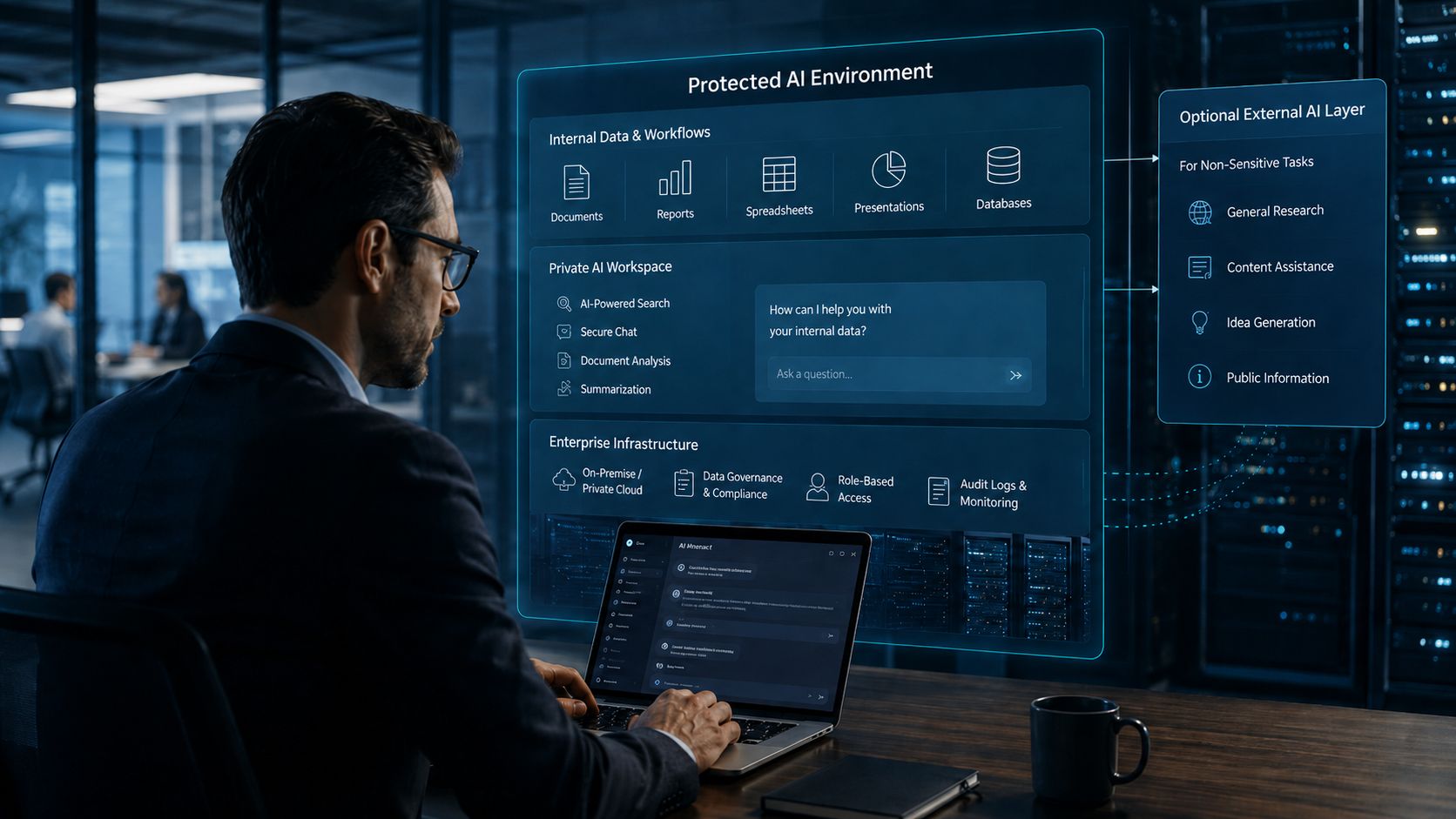
Our Hybrid AI Approach opens the gate to AI – only as far as you choose.
Developed and tested in collaboration with companies across different sectors.
Our Core Principles

Protection
No data leaves your company unless you allow it.
01

Efficiency
Local AI capabilities tailored to your business.
02

Flexibility
Optional access to advanced external AI for non-sensitive tasks.
03
Explore Our Implementation Packages
Choose the package that best fits your requirements – from privately hosted AI with full control to a semi-closed environment with optional access to current AI models. We have the right package for your business.
1 Protected Internal AI Infrastructure
For companies that want AI capabilities fully inside their own environment.
Typical Internal Use Cases:
- Internal Knowledge Search
- Document Summarization
- Local OCR and Digitization
- Internal AI Assistant
- Technical Support Knowledge Base
- Secure Business Drafting
2 Hybrid AI Infrastructure – Protected Internal + External
For companies that want internal AI first, but optional access to external high-end models from one interface.
Typical External Use Cases
- Market Research & Trend Analysis
- Marketing & Public Content Creation
- Sales & Outreach Preparation
- Public Documentation & Knowledge Structuring
- Research, Ideation & Concept Development
- Translation, Rewriting & Language Polishing
- Coding Support & Issue Fixes
3 Custom AI Infrastructure
A tailored AI environment for special workflows, server setups, integrations or business requirements.
4 Local AI Setup
A local AI setup for professionals, founders and small teams working from a home office or private office environment.
Implementation Steps
1 Requirements Check
We clarify use cases, users, documents, hardware and target workflows.
2. Infrastructure Setup
You receive a clear proposal: internal, hybrid or custom setup.

3. Installation & Configuration
We set up local AI components, interfaces, search/indexing and optional routing.
4. Testing
The setup is tested with typical tasks and sample documents.
5. Handover
You receive technical documentation and overview of how the system is structured, maintained and extended.
6. Optional Maintenance
If needed, we support updates, model changes, technical checks and future extensions of your AI infrastructure.
Your Partner for AI Infrastructure
We bring together our experience in AI, software development, and digital infrastructure to support your long-term success.

Dr. Jörg Heinze
CEO
“AI is here to stay. Now it is time to make its use secure, structured, and professional.“
As a former consultant and software developer, Dr. Jörg Heinze has led AI implementation projects for companies and digital platforms across different sectors.
His own concern about using AI for important business tasks while keeping sensitive data under control led to the development of Protected AI. The idea behind it is simple: companies should be able to use modern AI capabilities without exposing confidential information through uncontrolled tool usage.
Early pilot projects showed that the Protected AI architecture can significantly professionalize AI usage in SMEs. Internal processes become more robust, sensitive workflows stay protected, and approved use cases can still benefit from high-performance AI models.
From our base in Munich, we support companies across different regions and industries. Digital infrastructure allows us to implement local, private, and hybrid AI environments independent of location.
Can we run AI completely inside our company network?
Yes. A Protected Internal AI setup can be designed so that the AI model, document processing, search index and user interface run fully inside your own infrastructure. In this configuration, prompts, documents and generated answers do not need to leave the company network.
This is suitable for companies that want to use AI for internal documents, knowledge search, summarization or drafting without relying on public AI chat tools for sensitive workflows.
Can we reach the same quality as ChatGPT with local AI?
Not always. Fully local AI models can be very useful for internal knowledge work, document search, summarization, drafting and technical support. However, the strongest cloud-based frontier models may still perform better for complex reasoning, very broad world knowledge or highly demanding creative tasks.
That is why we offer both internal and hybrid AI infrastructure. Sensitive work can stay local, while selected non-sensitive or approved tasks can optionally be routed to external high-end models if the company chooses this setup.
What is the difference between internal and hybrid AI infrastructure?
Internal AI infrastructure means that the AI system runs inside your own environment. Local models, document processing, search and user interaction are handled internally.
Hybrid AI infrastructure adds a controlled external option. The system still uses internal AI first, but selected tasks can be routed to external AI models when explicitly allowed. This gives companies more flexibility: sensitive workflows stay internal, while non-sensitive or approved tasks can use stronger external models.
Can scanned documents be processed locally with OCR?
Yes. Scanned documents can be processed locally with OCR so that paper documents, PDFs or image files become searchable text. The extracted text can then be indexed and made available to an internal AI assistant.
This allows companies to build internal document search, knowledge assistants or archive workflows without automatically sending scanned documents to external cloud services.
Do we need new hardware?
Not necessarily. The right setup depends on the use case, the number of users, the amount of documents and the expected performance level.
Some smaller setups can run on an existing workstation or mini server. Larger company setups may require a dedicated AI server with sufficient CPU, RAM, storage and possibly GPU performance. As part of the setup, we evaluate the existing infrastructure and recommend the most practical hardware option.
Is this a SaaS subscription?
No. Protected AI is not another AI SaaS subscription. We provide setup, configuration and implementation services for AI infrastructure based on existing tools and your own environment.
Depending on the package, there can be optional ongoing maintenance costs for updates, technical support, model changes or infrastructure checks. External software licenses, cloud costs or hardware costs are not included unless explicitly agreed.
Can the system be extended later?
Yes. A Protected AI setup can be extended step by step. You can start with a local AI assistant, then add internal document search, OCR processing, additional models, more users, external model routing or integrations with existing systems.
The infrastructure is designed to be practical at the beginning and expandable when the use cases become clearer.
Companies with sensitive workflows trust Protected AI to build controlled AI infrastructure.
Many started with the same challenge: AI was already being used, but without a secure internal setup or a clear separation between confidential and non-sensitive tasks. What changed with Protected AI, they explain in their own words.
“We did not want another generic AI subscription. We wanted infrastructure that fits our business. Protected AI delivered a setup that gives us more control over how AI is used.”
★
★
★
★
★

Daniel Wang
Manager of AI Technology
Novastra Systems
“Before working with Protected AI, AI usage in our company was fragmented and hard to control. Now we have a dedicated setup that makes AI usable, structured, and much easier to manage.”
★
★
★
★
★

Peter Evans
Managing Director
Kernfeld Industrial Solution
“Protected AI helped us move from scattered AI experiments to a structured infrastructure. Sensitive workflows now stay internal, while approved use cases can still benefit from powerful external models.
★
★
★
★
★

Elisabeth Mayer
Data Protection Officer
Lynora Health Services
Contact
READY TO PROTECT YOUR BUSINESS AI USAGE
What is a protected AI
A protected AI is an artificial intelligence environment designed to give companies more control over how data is processed, where AI tasks are executed, and when external AI models are used. Instead of relying only on public AI tools, a protected AI setup creates a controlled infrastructure for business use cases involving internal documents, customer information, technical knowledge, or confidential workflows.
In practice, protected AI can mean different levels of protection. The strongest version is a fully internal AI environment. In this setup, language models, document processing, search indexes, OCR workflows, and the user interface run inside the company’s own infrastructure or a dedicated private environment. Sensitive prompts, documents, and generated answers stay within this controlled system. This makes protected AI especially relevant for companies that want to use AI with internal knowledge without sending business-critical information to uncontrolled external tools.
A second approach is hybrid AI infrastructure. Here, sensitive tasks remain internal, while non-sensitive or approved tasks can be routed to external high-performance AI models. This allows companies to benefit from the latest AI capabilities without giving up control over confidential workflows. For example, internal document search, OCR digitization, summarization of confidential files, and technical knowledge bases can stay inside the protected environment. At the same time, external models can be used for non-sensitive public market research, marketing content, translation, coding support, or other tasks that do not require sensitive company data.
Protected AI is not a single software product. It is an infrastructure approach. It combines local AI models, private servers, document search, access structures, optional external model routing, and technical maintenance into one practical environment. The goal is to make AI usable in everyday business operations while reducing uncontrolled data exposure.
For companies, protected AI closes the gap between two extremes. Public AI tools offer strong performance, but they are not the right place for every type of business information. Purely local AI keeps data under control, but it does not deliver the same performance as the latest external AI models. A protected AI infrastructure combines both worlds: internal AI for sensitive workflows and optional external AI access for approved high-performance tasks.
Protected AI helps companies use modern AI capabilities in a structured, secure, and scalable way. It gives teams access to AI where it creates value, while keeping control over the information that should remain inside the business.